Free carrier vetting

Everything the federal government records about a motor carrier is scattered across a dozen separate systems: registration, operating authority, insurance filings, roadside inspections, crashes, safety measurement, equipment. The SAFER snapshot most brokers check reads just one of them. No broker has time to open all the rest, and the raw feeds are noisy. fleetfax pulls the public record together into one report, cleans it, and surfaces what actually matters.

The power is in how the data connects. fleetfax cross-references the sources: the trucks a carrier runs against the trucks it reports, its identity against carriers whose authority was already pulled, its safety against carriers its own size. You see how the pieces line up, or don't, instead of one slice at a time.

fleetfax is powered by 40+ million federal records, updated daily: 4.4M carriers, 8.2M inspections, 4.9M crashes, 7.3M insurance filings, plus authority changes, out-of-service orders, and safety-measurement records.

How to vet a carrier in three steps

Step 1

Search the carrier

Enter a USDOT or MC number, company name, phone, or email. fleetfax pulls the matching federal record.

Step 2

Read the report

Risk flags up top, then authority, insurance, safety vs peers, inspections, crashes, fleet detail, and an operating map.

Step 3

Save the record

Export a timestamped PDF for the compliance file, generated on your device, with a link back to the live report.

What it looks like on a real carrier

One carrier, pulled together from the federal record. These are real screenshots from the report.

The read
Findings first, each one you can open
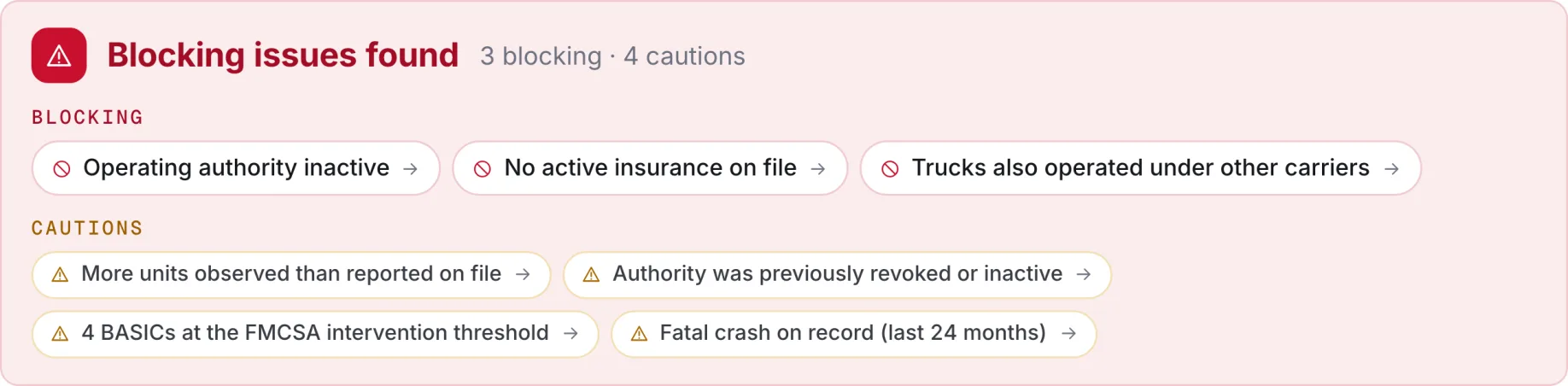
fleetfax verdict for a real carrier: three blocking issues and four cautions, including trucks operated under other carriers and more units observed than reported
fleetfax reads the public federal record for a carrier, reconciles it, and leads with what matters. Blocking issues are hard problems like an inactive authority or no insurance on file. Cautions are things worth a closer look. Several findings here only exist because we cross-reference sources, like trucks seen running under other carriers. Reading it. Blocking and caution describe the record, not a decision. Every finding opens to the data behind it, so you can judge it yourself.
Where they operate
A map built from inspections, not an address
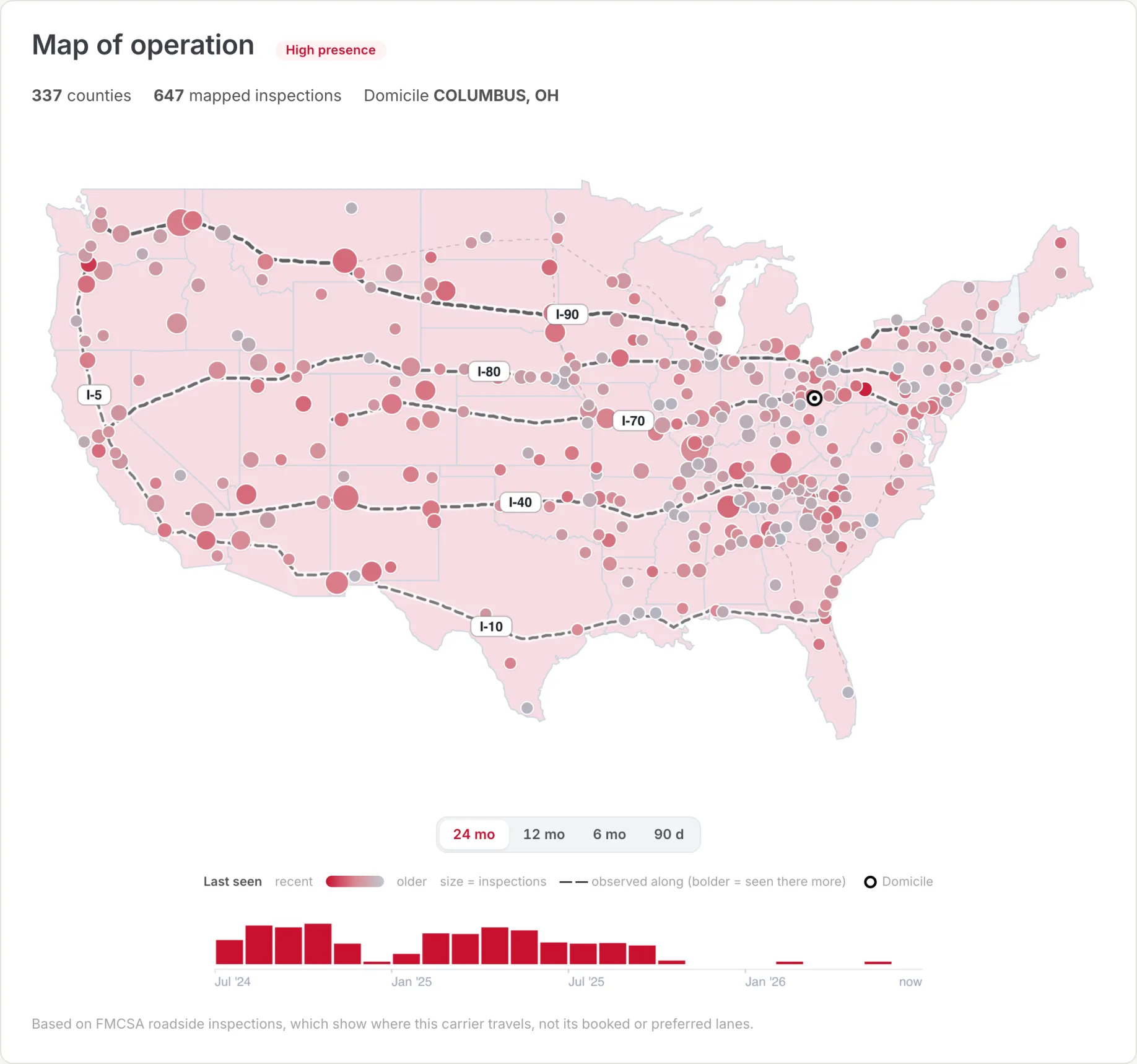
fleetfax operating map for a real carrier, drawn from 647 roadside inspections across 337 counties, with interstate corridors and a domicile marker
Every roadside inspection carries a location and a date. fleetfax plots them: bigger dots mean more inspections in a place, and the shading shows the carrier's real operating footprint over the window you choose. This one is built from 647 inspections across 337 counties. Reading it. This is where the trucks were actually pulled in, which is hard to fake. Compare it to the address and lanes the carrier claims. One domiciled in a state but only ever seen far from it is worth a question.
Safety vs peers
Measured against carriers its own size
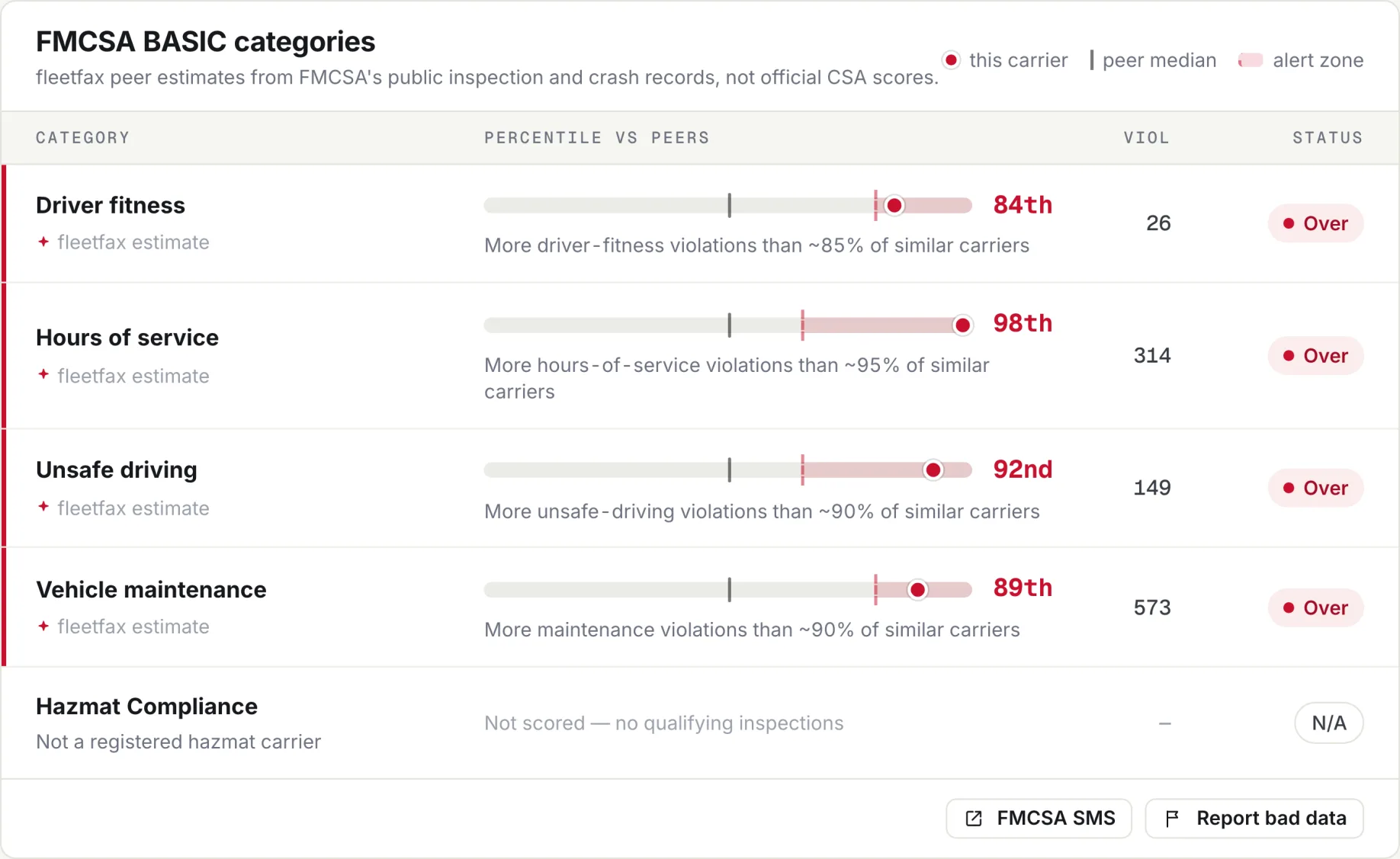
fleetfax safety percentiles for a real carrier, showing four FMCSA BASIC categories above the peer alert threshold with violation counts
fleetfax groups a carrier with others of similar fleet size, counts violations per inspection from the public record, and shows where it lands as a percentile. These are fleetfax peer estimates, not the official CSA scores FMCSA keeps private. Reading it. A high percentile means more violations than most similar carriers, not a pass or fail. The alert zone marks roughly where FMCSA steps in. The counts and the inspections behind each bar are all there.
The fleet
The trucks it actually runs, decoded
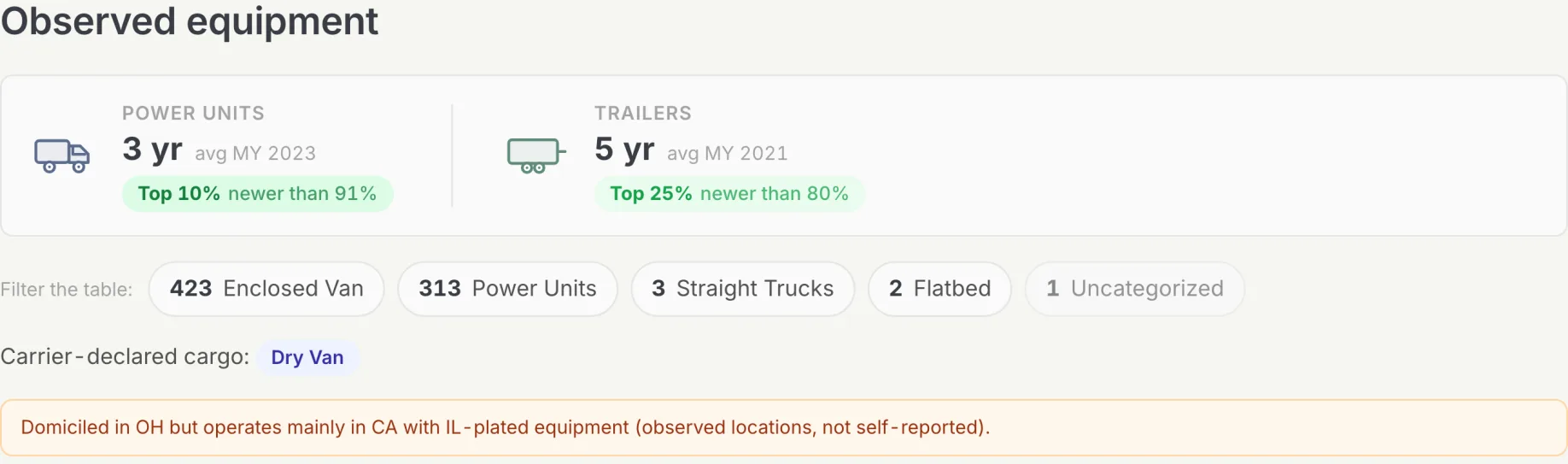
fleetfax fleet summary for a real carrier: power units averaging three years old and in the top 10 percent for age, the equipment mix, and a note that the carrier is domiciled in Ohio but operates mainly in California with Illinois-plated equipment
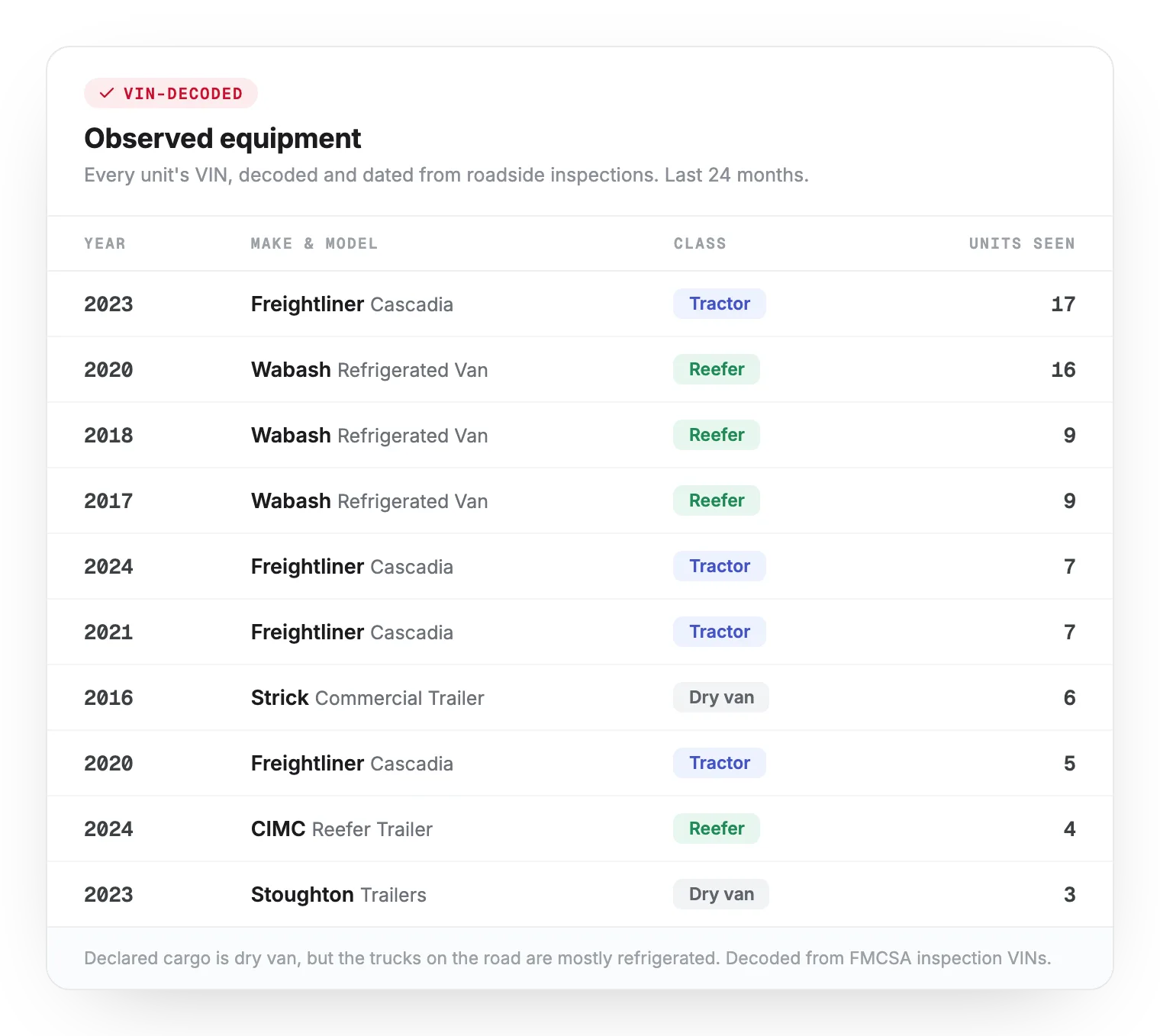
A decoded equipment table for a real carrier: ten units by year, make and model (Freightliner Cascadia tractors, Wabash refrigerated vans, Strick and Stoughton dry-van trailers), each classified from its VIN, showing the carrier runs mostly reefers despite declaring dry van
fleetfax decodes the VIN of every truck and trailer seen in a carrier's inspections, then dates and classifies the equipment and compares its age to other carriers. It also lines the fleet up against where the carrier is observed to run and what it reports as its base. Reading it. This is the fleet on the road, not a number on a filing. Newer than peers often points to a real, invested operator. A mismatch, like equipment plated far from the carrier's base, is the kind of thing worth asking about.

What's in every report

Free, for any carrier, with the records behind each line.

Status and operating authority

Whether it's active and which authority types it holds, with the full history of grants, revocations, and reinstatements. An authority revoked once and reinstated looks active today, but reads differently with the history attached.

Insurance on file

The filings on record, with a routine annual term-end told apart from a real cancellation, so a normal renewal never reads as a lapse. No active insurance on file surfaces as a blocking issue.

Safety vs same-size peers

Out-of-service and crash rates as percentiles against carriers of similar size, with the trend over time and the individual inspections and crashes behind every number.

Where they're observed to operate

A map drawn from where the carrier's trucks were actually inspected, so you can see where it really runs. A lot harder to fake than the address on a filing.

Fleet, reconciled

The trucks reported on the MCS-150 against the trucks actually seen in inspections, plus equipment age vs peers. When the reported fleet and the observed fleet don't line up, that surfaces as a flag.

Cross-referenced risk signals

The identity-overlap patterns behind double-brokering and reincarnated carriers, surfaced by reconciling a carrier's record against the rest of the federal data. Each one is a named flag with the evidence behind it.

Vetting that surfaces facts, not a pass or fail

Fraud and double-brokering are the industry's biggest worry right now, and a carrier built to scam is built to pass a quick glance. Reports to the Transportation Intermediaries Association rose 65% in the six months ending February 2025, and in one six-month stretch, 22% of brokers lost more than $200,000 to it. Reading deeper is the whole point: authority granted last week with no inspection history, an open out-of-service order, no insurance on file, or an identity reused from a carrier whose authority was already pulled. fleetfax surfaces each of those as a named flag with the record attached.

The exposure isn't only financial. In May 2026, the Supreme Court ruled unanimously in Montgomery v. Caribe Transport II that brokers can face state negligence claims over the carriers they select. That makes a carrier's federal record matter more than it used to.

fleetfax is descriptive by design. It tells you what the record shows (blocking issues found, a count of cautions, or nothing flagged as of the day you check) and links every claim to its evidence. It will never call a carrier safe or clear to book. A clean report is one input to your decision, not a replacement for your process.

Free carrier vetting FAQ

Is carrier vetting on fleetfax really free?

Yes. Every carrier report is free at full depth: no lookup cap, no trial, no credit card, no account. The single-carrier vetting report will always be free.

What does fleetfax check when vetting a carrier?

Operating authority and status, insurance filings on file, roadside inspections and out-of-service rates, crashes, fleet and equipment detail, a map of where they are observed to operate, and named risk flags including the identity-overlap patterns behind double-brokering, all read from the public FMCSA datasets.

Does fleetfax decide whether to book the carrier?

No. fleetfax gives you the facts and the patterns: the public record, the cross-referenced signals, and the evidence behind each one, so you can make an informed call. The decision to book is always yours. fleetfax never says safe-to-book or do-not-book, and it computes no single score.

Do I need an account or a credit card?

No. There is no signup, no card, and no login. Search a carrier and read the report. A Chrome extension brings the same check to wherever you find carriers.

How is free fleetfax different from other vetting tools?

fleetfax goes deeper on the single-carrier read. Because the data is public, we ingest the federal record ourselves and reconcile it: safety measured against same-size peers, a map of where the carrier is observed to operate, the fleet checked against what's reported, and the identity-overlap signals behind double-brokering. The full report is free, with no account.

fleetfax reads public FMCSA data and is not affiliated with FMCSA or the U.S. Department of Transportation. A clean report is not legal cover or a substitute for your own process or policy.

Vet any carrier, free.

Search by USDOT, MC, name, phone, or email. The full report is free.

Run a free carrier check

Free forever. No signup. No card. No data sold.

Prefer it in your browser? Get the Chrome extension →