Skip to content
fleetfax
Source Find carriers on a laneType the lane in plain English, get carriers observed running it Find carriers near a cityEveryone eligible within a radius of your origin How the ranking worksLane evidence, safety vs peers, observed activity. Never paid placement
Vet Carrier reportThe whole federal record in one report Risk flagsFraud patterns caught in every report PolicyYour own minimums, measured on any carrier you open Bulk vettingProVerdicts for a whole list at once ConnectionsProCarriers sharing a phone, address, or officer
Monitor Watchlist & alertsChanges on your carriers, in your account within a day Change timelineProFull federal timeline for 12 months, plus field-level identity changes Insurance early warningProCancellation filings on the carriers in your book Proof of vettingDated records of every check, on Pro
Chrome extension Due diligence, anywhere you work
API access The whole carrier record as JSON, coming soon
Research
The thief books the loadCargo theft has gone white-collar: the load is stolen on paper, with a borrowed identity, a purchased MC number, or a hijacked FMCSA registration account.8 min read When the record goes quietFMCSA's new public feeds can drop insured carriers with no marker. About 1 in 18 reading “lapsed” were insured all along when checked live.6 min read Reopened, not reformedCarriers shut down for cause quietly reopen under a new USDOT number, and crash at 3.6× the rate.4 min read
All research →
Resources

Guides

How to vet a carrier USDOT vs MC numbers Glossary FAQ

Trust

How fleetfax reads the record
Tools

Live data

Daily digestNew carriers, authorities, and revocations, counted daily. Out-of-service trackerNational vehicle and driver out-of-service rates from roadside inspections. Fleet age trackerThe age of power units seen in recorded inspections.

Status

FMCSA statusLive availability of the federal data systems fleetfax reads.
Pricing
Search a carrier⌘K Log in Get started free

Source

Find carriers on a lane Find carriers near a city How the ranking works

Vet

Carrier report Risk flags Policy Bulk vettingPro ConnectionsPro

Monitor

Watchlist & alerts Change timelinePro Insurance early warningPro Proof of vetting

Extension

Chrome extension

Developers

API access (coming soon)
Research

Tools

Daily digest Out-of-service tracker Fleet age tracker FMCSA status Resources Pricing
Log in Get started free
Vet

Catch what a clean lookup misses

Reincarnated authorities, rented MC numbers, insurance lapses, safety against peers. The whole federal record on any carrier, read for you, with no account and no card.

  • Auto
  • DOT
  • MC
  • Name
  • Phone
  • Email

    Free on any carrier. No account, no card.

    The carrier report

    Everything on a carrier, in one report

    Authority, insurance, inspections, safety history, ownership. Everything you check when you vet a carrier, pulled into one place and stated as facts.

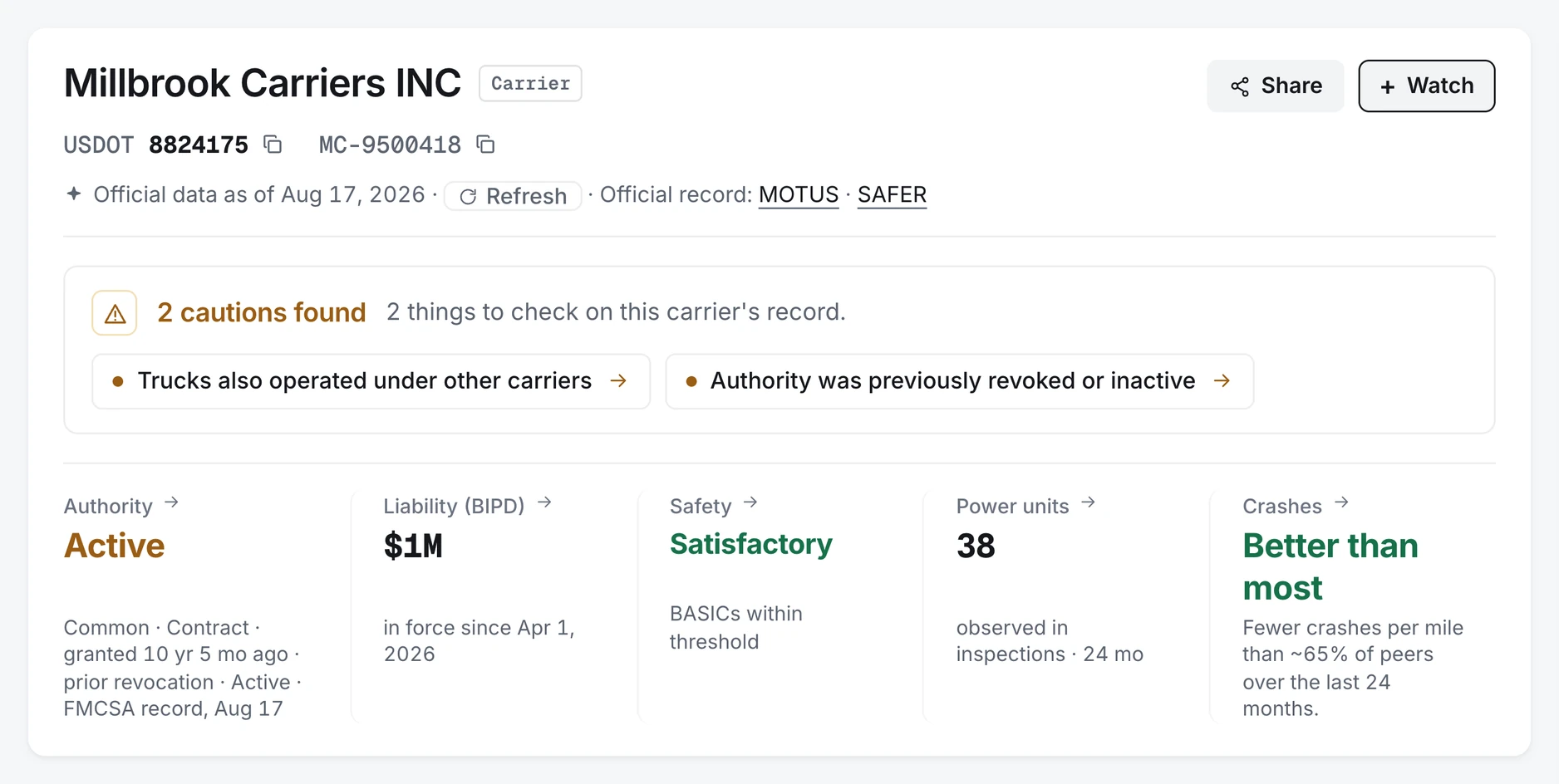
    The fleetfax carrier report header: carrier name, USDOT and MC numbers, a line reading official data as of the date the record was pulled, then a verdict card reading 2 cautions found with the two findings named, and beneath it authority active, $1M liability in force, rated Satisfactory, 38 power units observed in inspections, and fewer crashes per mile than about 65% of peers.

    The top of a report. The verdict comes first, then the record behind it: authority, insurance on file, safety against peers, and the trucks actually seen on the road. The line above the verdict names the day the federal record was read. An illustrative composite: the carrier is fictional, its DOT number is unissued, and every figure in frame was authored for this image. The same report is free on any carrier.

    Risk flags

    Fraud patterns caught in every report

    Freight fraud usually leaves a paper trail in the federal record. fleetfax looks for the patterns brokers get burned by and raises them as cautions, so you make the call with them in front of you. A few of the things it watches for:

    Reincarnation pattern Caution
    A prior authority at the same address and ownership closed with unresolved issues shortly before this one opened. Often a way to shed a bad record.
    MC-for-rent pattern Caution
    Authority holder and the operator on inspections do not line up, a signal the number may be rented out to unrelated trucks.
    Recent authority churn Caution
    Authority granted, revoked and reinstated in a short window, a record that tends to move around more than a settled carrier's.
    The fraud playbook

    How stolen loads actually start

    These plays start at a desk, not a truck stop. The thief books the load as somebody else, or as a company built to be burned, and the freight is gone before anyone knows to look. Each play leaves marks in the federal record. Here's where the report puts them in front of you.

    01
    Carrier impersonation
    A fraudster picks a real carrier with a clean record and books as them, from a lookalike email domain, with a phone number that rings at the thief's desk. The paperwork gets signed under the stolen name and the load disappears.
    In the reportThe carrier's contact details as filed on the federal record, so your callback goes to the number the carrier filed, not the number in the email.
    02
    Chameleon reopenings
    A carrier shut down for cause reopens under a new USDOT number with a spotless face, sometimes at the same address, under the same people. Weeks of clean, small loads build trust before the high-value freight gets diverted.
    In the reportThe reincarnation caution connects the new number to the closed one. We published the data on how often the official disclosure field misses these.
    03
    The holiday bust-out
    Theft rings time the play for long weekends: loads staged early, skeleton crews at the dock, and days before a receiver notices anything is missing. A carrier that looked fine at onboarding months ago is exactly what the play counts on.
    In the reportThe record as it stands the day you pull it, with new and churning authority flagged. The report is free, so checking again costs nothing.
    Peer safety percentiles

    Measured against carriers with a similar record

    Ten violations mean one thing at five hundred inspections and another at twelve. fleetfax compares each carrier against others with a similar inspection record.
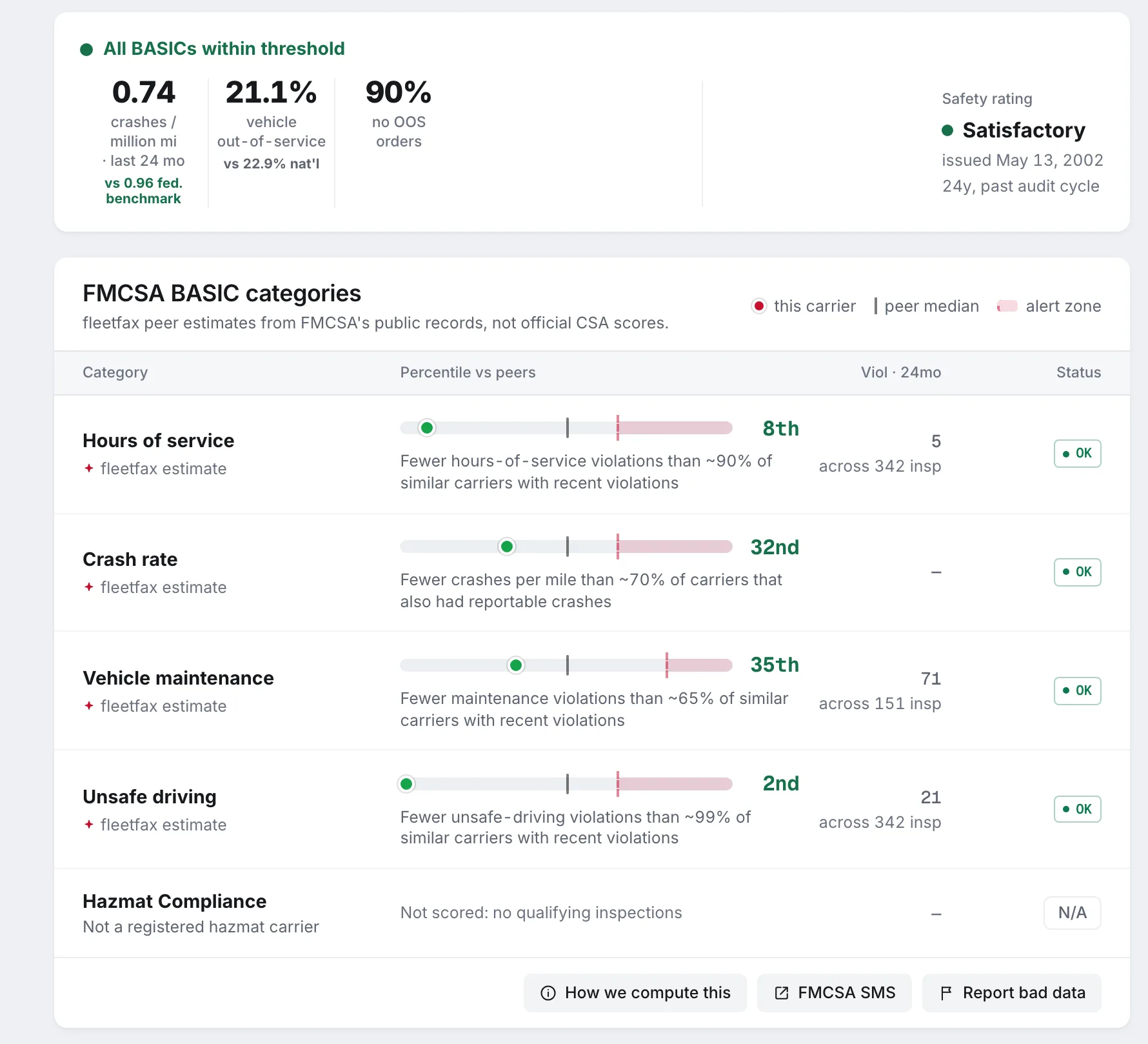
    The fleetfax report view of FMCSA BASIC percentiles for a carrier: crash rate and hours of service marked OK, unsafe driving over the peer alert threshold at the 89th percentile, vehicle maintenance and driver fitness elevated, controlled substances below the 50th percentile, hazmat not scored. Each row carries its violation count and the inspections behind it.

    Every carrier gets a percentile. Each one is grouped with carriers with a similar amount of inspection activity, then ranked on violations per inspection from the public record. The comparison pool is carriers that also had recent violations, and each row says so; crash rate is its own pool, measured per mile against carriers that also had recordable crashes. The status column is shorthand for where that percentile sits against FMCSA's alert threshold. A higher percentile means more violations than peers, not a pass or a fail. FMCSA keeps its own percentiles hidden, so these are fleetfax estimates built from the same public records, not official CSA scores.

    Authority & insurance history

    Every filing and lapse, going back years

    Not just today's snapshot. The full run of authority events and insurance filings, side by side, so a gap that closed two years ago still shows.
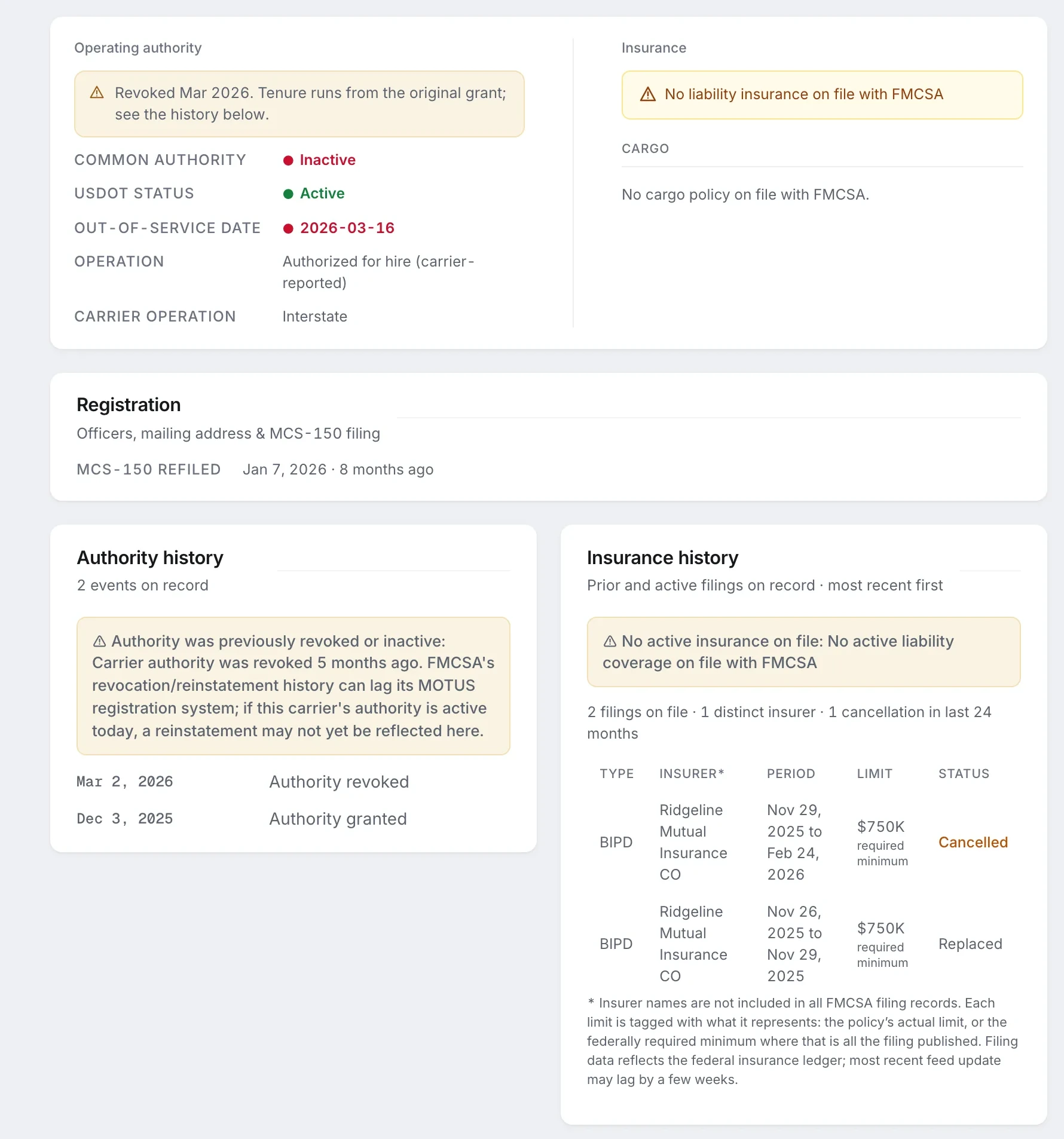
    The fleetfax authority and insurance history view for a carrier: authority granted December 2025 and revoked March 2026, alongside an insurance ledger showing a $750K liability policy cancelled with no replacement on file.

    Granted in December, revoked by March. An authority barely three months old, next to the insurance ledger that explains it: a $750K policy cancelled with no replacement on file. A packet from onboarding would still say this carrier was covered; the report shows the record as it stands today.

    Insurance, live-verified against Motus

    Every night, fleetfax checks unclear insurance records against FMCSA's Motus system, the registration system of record. When the public feeds lag, fleetfax corrects the insurance record to match what Motus shows.

    Read the research
    Observed fleet

    The trucks actually seen on the road

    fleetfax reads the VINs off roadside inspections and decodes them, then puts that next to what the carrier reports.

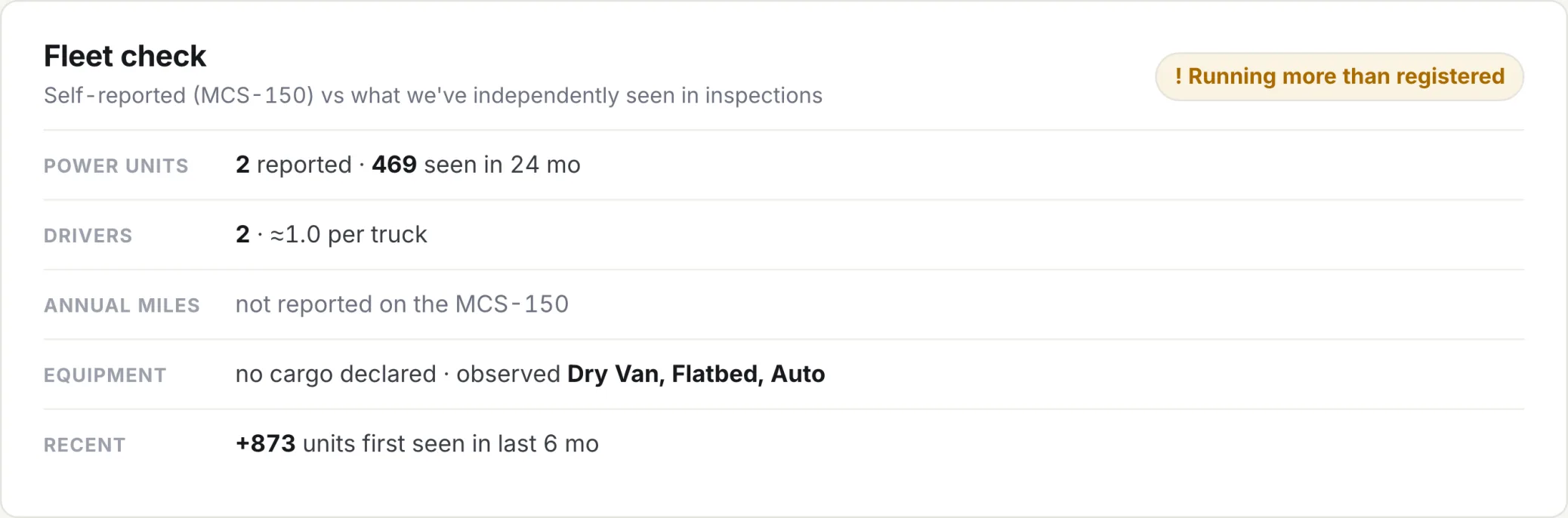
    The fleetfax fleet check flagged 'Running more than registered': the carrier reports 2 power units while 469 distinct power units were seen in inspections over 24 months, and 873 units including trailers were first seen in the last 6 months.

    2 reported, 469 observed. This carrier reports 2 power units to FMCSA; inspections saw 469 distinct trucks in 24 months, so the report flags it. Reported and observed are two separate facts, and not every truck gets inspected, so a gap is a reason to ask the carrier, not proof of anything by itself.
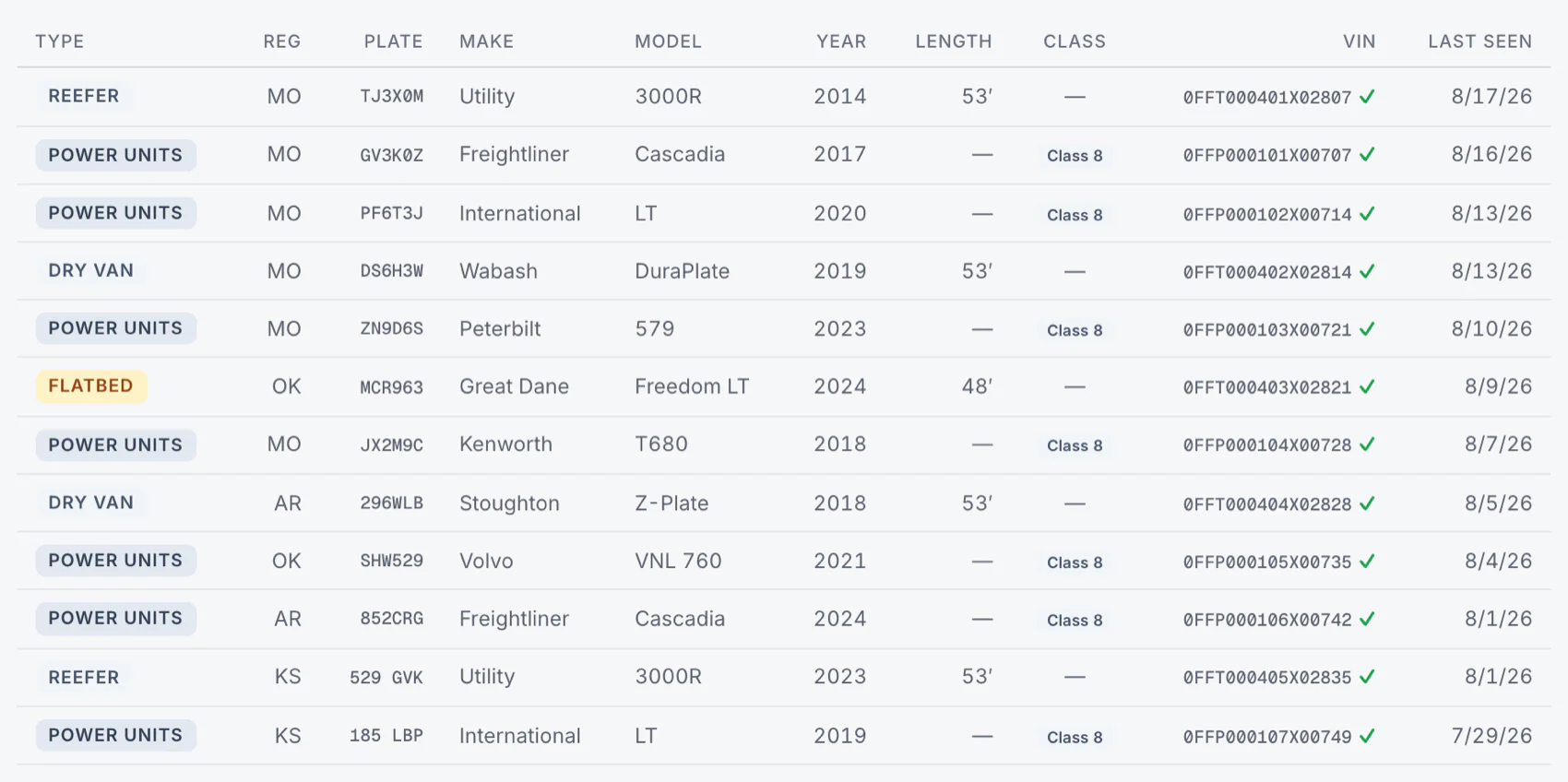
    The fleetfax Fleet tab observed-equipment table: each row is one truck or trailer seen in a roadside inspection, with its VIN and the make, model, year, and class decoded from it, plus when it was last seen.

    Decoded from roadside-inspection VINs. Each row is one truck or trailer seen in an inspection, with the VIN it was read from and the make, year, and class decoded from it. The carrier and VINs shown are fictional.

    Operating map

    Where a carrier actually runs

    Built from where the carrier's trucks have actually been inspected, not from a service area somebody filled in on a form.
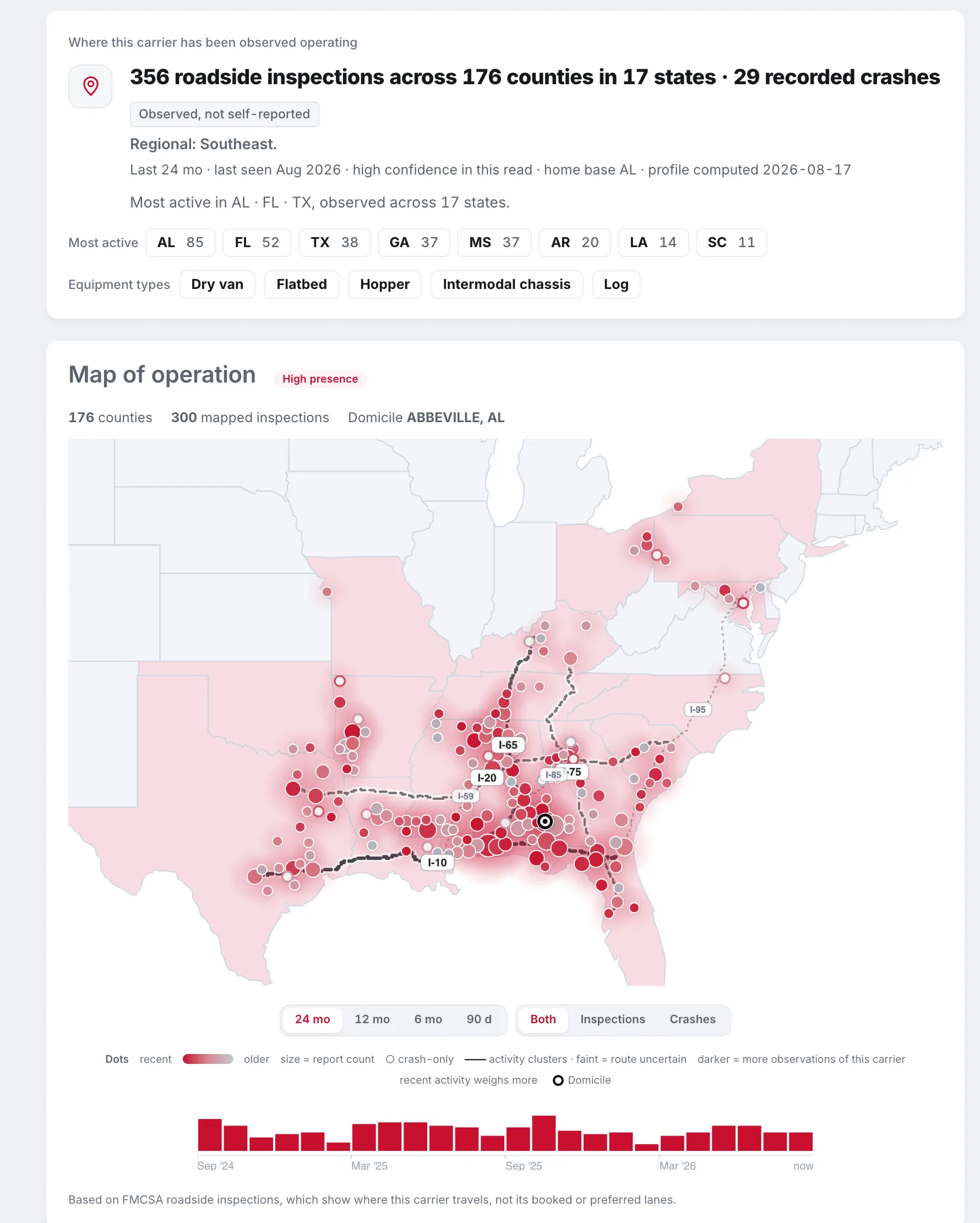
    The fleetfax operating map for a regional carrier: 88 counties and 325 mapped inspections across the Southeast, clustered along I-40, I-85, I-77 and I-95, with recency-graded inspection dots, a Salisbury, NC domicile and its ringed marker inside the busiest cluster, and an activity-over-time histogram.

    88 counties, 325 mapped inspections. A regional carrier that works the Southeast and stays there. Every dot is a roadside inspection, placed where the truck was actually stopped; the dashed lines are the corridors those stops keep landing on, and the ringed marker is the carrier's registered home base.

    Connections Pro

    Every carrier behind one phone, address, or name

    A report tells you about the carrier you looked up. Some of what matters only appears when you see everything filed under the same suite number, the same phone line, or the same officer. Reverse search starts from the detail instead of the carrier: search a phone, address, or name and walk from any result to whatever else it shares.

    The fleetfax graph explorer searching by address: five carriers share one suite address, listed with their USDOT numbers, active registration status, and a flag on each row reading multiple carriers at this address. The last row carries two further flags, vehicles previously operated by a revoked carrier and trucks also operated under other carriers, and its shared-key chips are open showing four more carriers reachable through the shared address.

    Reverse search opens with fleetfax Pro, which has not launched yet. Get notified when Pro opens.

    The report views on this page are illustrative composites, made in August 2026: the real report, rendered against carriers and figures authored for the images. Carrier names are fictional and their USDOT numbers unissued. The federal record moves daily, so the live report on any carrier will differ.

    Beyond one report

    Vetting one carrier is the easy part

    The report stays free on every carrier. A free account lets you hold any carrier you open to your own minimums. Pro is for the days you're running a whole book.

    Policy

    Build your qualification rules from 18 checks over the federal record, with your thresholds and your grading on each one. fleetfax reads any carrier you open as inside or outside your minimums, and tells you which rule decided it. Where the record can't settle a rule, it says so instead of guessing. These are your minimums, not a fleetfax grade. Writing a policy and reading one carrier against it, rule by rule, costs nothing; running it across your whole book is the Pro part.

    Bulk vetting

    Pro

    Paste a list or a CSV and get one verdict per carrier, up to 100 at a time and 2,000 a day. That's a whole book read in a pass or two instead of one tab at a time, with the same federal record behind every verdict as the single report. Importing a book is free; running them all at once is the Pro part.

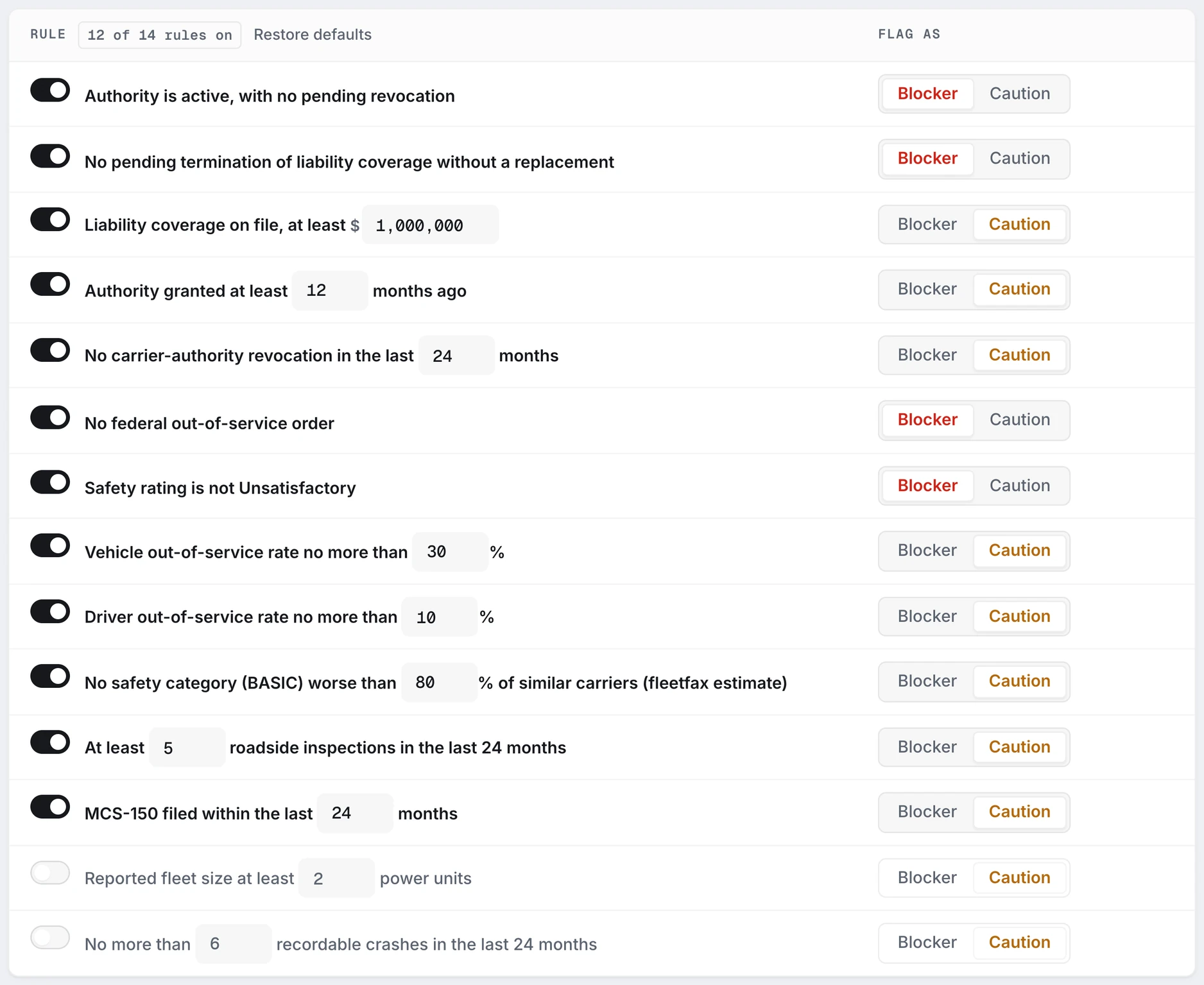
    The fleetfax policy editor: fourteen rules listed, twelve switched on, each written as a sentence with the broker's own number typed into it — liability coverage at least $1,000,000, authority granted at least 12 months ago, no revocation in the last 24 months, vehicle out-of-service rate no more than 30 percent, no BASIC worse than the 80th percentile. A blocker-or-caution control sits beside every rule.

    Every rule reads one field of the federal record directly. The numbers are yours, and so is the grading — fleetfax reports the facts against your line and never adds a verdict of its own. An illustrative composite: the rule set shown was authored for this image.

    Bulk vetting comes with Pro

    Pro hasn't launched yet. Leave your email and we'll write to you the day it goes live.

    You're on the list. We'll email you the day Pro goes live.

    fleetfax Pro opens soon, at a launch price you keep for as long as you stay subscribed.

    fleetfax

    Carrier intelligence for all. Source, vet, and monitor your carriers, free.

    Product Carrier report Chrome extension For carriers Pricing
    Free tools SAFER snapshot lookup Carrier vetting MC number lookup DOT number lookup FMCSA safety check
    Learn Research Resources Glossary Methodology FAQ
    Live data Industry stats Out-of-service trends Fleet age
    Company About Contact

    © 2026 fleetfax

    fleetfax LLC · 2108 N St, Ste N, Sacramento, CA 95816
    Privacy Terms Status
    fleetfax

    How's it going?