Free tool · carrier lookup

SAFER Company Snapshot lookup

  • DOT
  • MC
  • Name
  • Phone
  • Email

SAFER's Company Snapshot is the page most people mean by "checking SAFER": one carrier's registration, operating status, fleet size, inspection and crash summaries, and safety rating. The datasets behind it are public. fleetfax reads them daily and serves the same record here, in one free report, even when safer.fmcsa.dot.gov won't load.

The Snapshot shows one slice of the record. Vetting usually turns on the slices it leaves out: insurance filings, the full authority grant and revocation history, each individual inspection, where the carrier actually runs, and whether its identity overlaps a carrier that was already shut down. fleetfax reads all of it and turns what it finds into named flags, each with the records behind it.

fleetfax is powered by 40+ million federal records, updated daily: 4.4M carriers, 8.4M inspections, 4.9M crashes, 7.3M insurance filings, plus authority changes, out-of-service orders, and safety-measurement records.

Everything the Snapshot shows, and what it leaves out

Both read the public federal record. The difference is how much of it you see.

What you need SAFER Company Snapshot fleetfax report (free)
Registration & status USDOT, entity type, operating status, address, fleet and driver counts, safety rating. The same record, plus the reported numbers reconciled against what's actually observed in inspections.
Operating authority Current authority status. The full history: grants, revocations, reinstatements. An authority revoked once and reinstated looks active today, but reads differently with the history attached.
Insurance Not displayed; points you to a separate FMCSA system. Filings on file, with a routine annual term-end told apart from a real cancellation. No active insurance on file surfaces as a blocking issue.
Inspections & crashes 24-month summary counts and out-of-service percentages. Every individual inspection and crash, the trend over time, and safety measured as percentiles against same-size peers.
Where they operate The address on the filing. A map drawn from where the trucks were actually inspected. A carrier domiciled in one state but only ever seen far from it is worth a question.
Fleet & equipment Reported power unit and driver counts. The equipment actually seen in inspections, VIN-decoded by year, make, and model, with fleet age compared to peers.
Fraud patterns Not covered. Named risk flags for the identity-overlap patterns behind double-brokering and reincarnated carriers, each with the records behind it.

Snapshot column reflects what safer.fmcsa.dot.gov displays on the Company Snapshot page as of July 2026. fleetfax is not affiliated with FMCSA; both read the same public federal datasets.

The same lookup on fleetfax

One carrier, pulled together from the federal record. These are real screenshots from the free report.

The read
Findings first, each one you can open
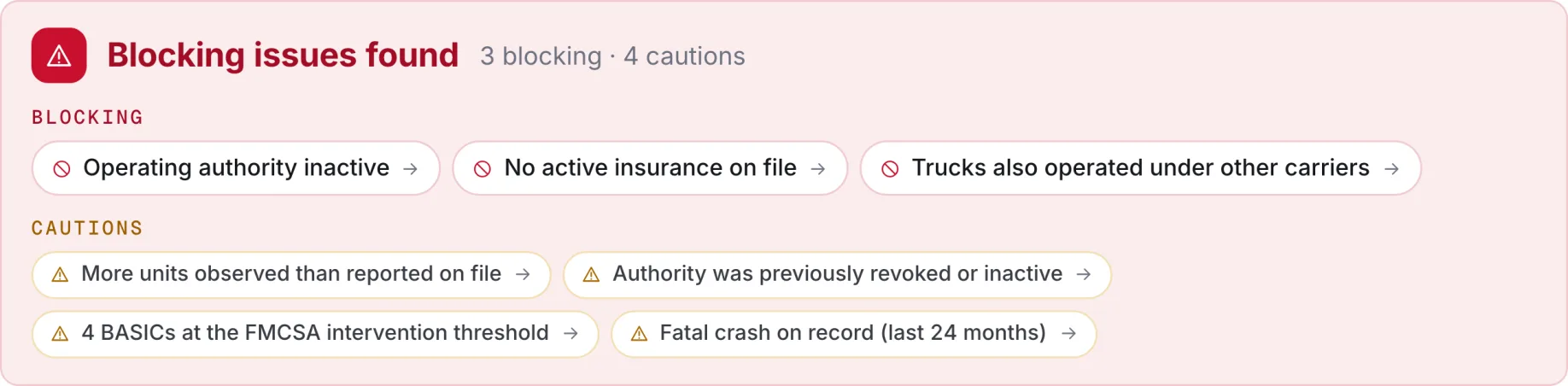
fleetfax verdict for a real carrier: three blocking issues and four cautions, including trucks operated under other carriers and more units observed than reported
fleetfax reads the public federal record for a carrier, reconciles it, and leads with what matters. Blocking issues are hard problems like an inactive authority or no insurance on file. Cautions are things worth a closer look. Several findings here only exist because we cross-reference sources, like trucks seen running under other carriers. Reading it. Blocking and caution describe the record, not a decision. Every finding opens to the data behind it, so you can judge it yourself.
Where they operate
A map built from inspections, not an address
fleetfax operating map for a real carrier, drawn from 647 roadside inspections across 337 counties, with interstate corridors and a domicile marker
Every roadside inspection carries a location and a date. fleetfax plots them: bigger dots mean more inspections in a place, and the shading shows the carrier's real operating footprint over the window you choose. This one is built from 647 inspections across 337 counties. Reading it. This is where the trucks were actually pulled in, which is hard to fake. Compare it to the address and lanes the carrier claims. One domiciled in a state but only ever seen far from it is worth a question.
Safety vs peers
Measured against carriers its own size
fleetfax safety percentiles for a real carrier, showing four FMCSA BASIC categories above the peer alert threshold with violation counts
fleetfax groups a carrier with others of similar fleet size, counts violations per inspection from the public record, and shows where it lands as a percentile. These are fleetfax peer estimates, not the official CSA scores FMCSA keeps private. Reading it. A high percentile means more violations than most similar carriers, not a pass or fail. The alert zone marks roughly where FMCSA steps in. The counts and the inspections behind each bar are all there.
The fleet
The trucks it actually runs, decoded
fleetfax fleet summary for a real carrier: power units averaging three years old and in the top 10 percent for age, the equipment mix, and a note that the carrier is domiciled in Ohio but operates mainly in California with Illinois-plated equipment
A decoded equipment table for a real carrier: ten units by year, make and model (Freightliner Cascadia tractors, Wabash refrigerated vans, Strick and Stoughton dry-van trailers), each classified from its VIN, showing the carrier runs mostly reefers despite declaring dry van
fleetfax decodes the VIN of every truck and trailer seen in a carrier's inspections, then dates and classifies the equipment and compares its age to other carriers. It also lines the fleet up against where the carrier is observed to run and what it reports as its base. Reading it. This is the fleet on the road, not a number on a filing. Newer than peers often points to a real, invested operator. A mismatch, like equipment plated far from the carrier's base, is the kind of thing worth asking about.

If SAFER is down or slow

FMCSA takes SAFER down for maintenance windows, and the site has slow stretches. The record doesn't go down with it. The datasets behind the Company Snapshot are public, and fleetfax serves them from its own daily ingestion, so the search at the top of this page keeps working when the government site doesn't. The official Snapshot lives at safer.fmcsa.dot.gov, fleetfax tracks FMCSA service uptime on a live status page, and anything fleetfax shows can be checked against the federal sources.

You still make the call

fleetfax keeps the part of SAFER worth keeping: it reports the record and stops there. A hard problem, like an inactive authority or no insurance on file, shows up as a blocking issue. A pattern worth a closer look shows up as a caution. Every finding opens to the records behind it. There is no pass or fail and no single score. You get more of the record to judge with, and the judgment stays yours.

SAFER Company Snapshot FAQ

Is this the official FMCSA SAFER system?

No. fleetfax is not affiliated with FMCSA or the U.S. Department of Transportation. The official Company Snapshot lives at safer.fmcsa.dot.gov. fleetfax reads the same public federal datasets, ingests them daily, and assembles them into one free report.

Does fleetfax show the same data as the SAFER Company Snapshot?

The core record is the same: registration, operating status, authority, fleet size, inspection and crash summaries, and safety rating. fleetfax adds the layers the Snapshot does not display, including insurance filings, the full authority grant and revocation history, each individual inspection and crash, safety measured against same-size peers, a map of observed operations, and named risk flags.

What can I do if SAFER is down or slow?

The datasets behind the Company Snapshot are public, so the record does not go down with the website. fleetfax serves the same carrier record from its own daily ingestion, free, with no account.

Why can't I find a carrier on SAFER?

SAFER lookups want an exact USDOT number, docket number, or name. fleetfax also resolves MC numbers to the right USDOT automatically and matches partial company names with suggestions as you type, plus phone and email lookups.

Is the fleetfax carrier lookup free?

Yes. Every carrier report is free at full depth: no lookup cap, no trial, no credit card, no account. The single-carrier report will always be free.

fleetfax reads public FMCSA data and is not affiliated with FMCSA or the U.S. Department of Transportation. A clean report is not legal cover or a substitute for your own process or policy.

Pull the full record, free.

Search by USDOT, MC, name, phone, or email. Everything the Snapshot shows, and the rest of the record with it.

Look up a carrier

Prefer it in your browser? Get the Chrome extension →